 vikram@gmail.com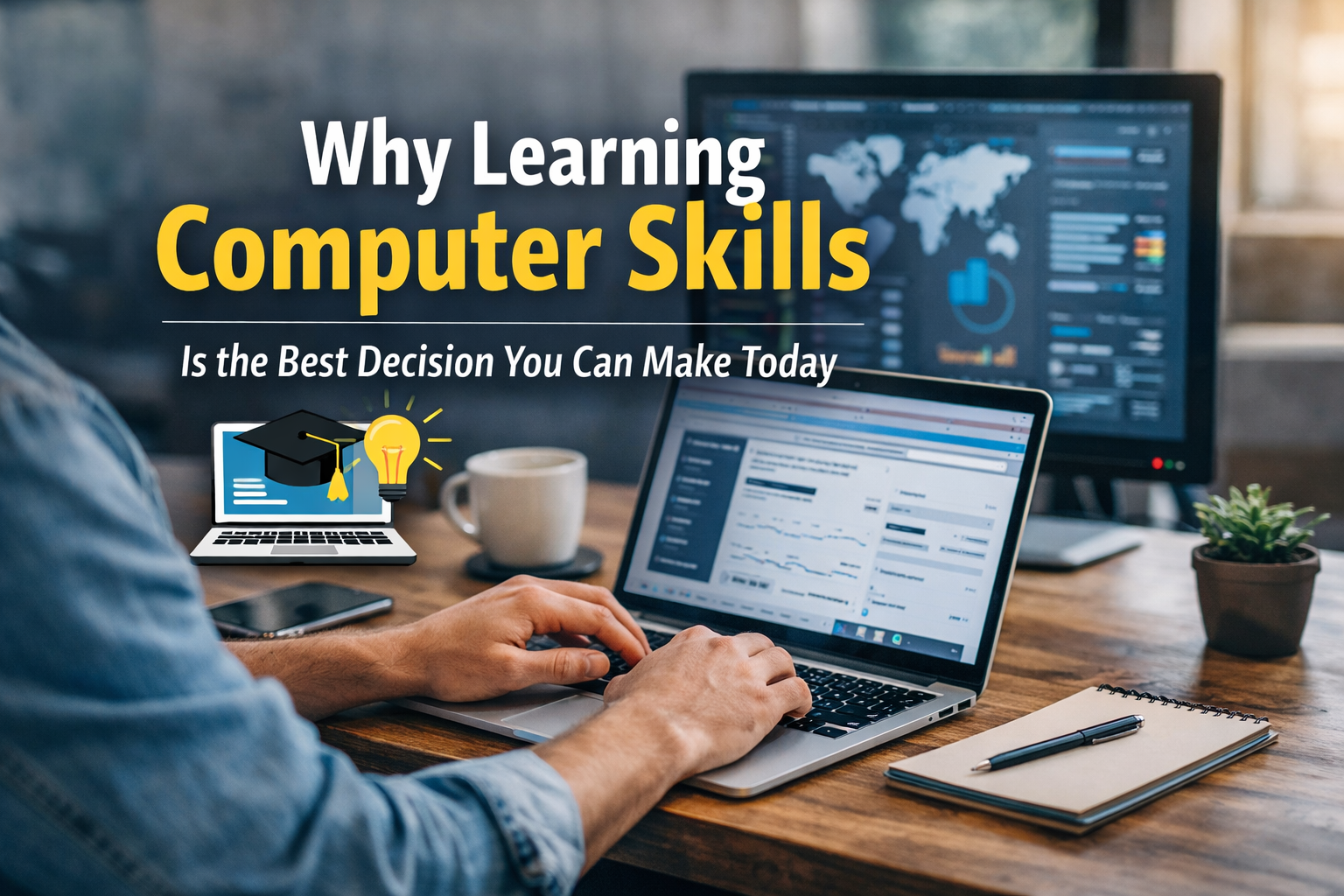
INTERODUCTION:-
Have you been wanting to learn how to use a computer but did not know where to start? You have come to the right place. This guide on basic computer skills for beginners covers everything from turning on your PC to browsing the internet safely. Whether you are a student, a job seeker, a homemaker, or a senior citizen — this guide is written especially for you.
No difficult language. No confusing terms. Just simple, honest, step-by-step instructions that anyone can follow.
Let’s begin!
Why Learning Computer Skills Is So Important Today
Before we dive into the actual basic computer skills for beginners, let us talk about why this knowledge matters so much in today’s world.
Everything around us is becoming digital. Jobs, education, banking, shopping, healthcare, and government services — all of it is moving online. People who know how to use a computer confidently have a massive advantage in life.
Here is what you gain when you learn:
- Higher chances of getting a good job
- Ability to study online for free from home
- Easy and fast communication with anyone in the world
- Access to online banking, bill payments, and shopping
- Freedom to work from home as a freelancer or remote employee
The sooner you start, the sooner your life gets easier. So let’s get right into it!
Part 1 — Understanding the Parts of Your Computer
The very first step in mastering basic computer skills for beginners is knowing what each part of the computer is and what job it does. Once you understand the hardware, everything else becomes easier.
Monitor
The monitor is the screen you look at. Everything happening on the computer is displayed here — text, images, videos, and apps. Think of it like a television set for your computer.
CPU (Central Processing Unit)
The CPU is the main box or tower that contains the computer’s brain. It holds the processor, RAM memory, and storage drive. All the heavy computing and processing happens inside here.
Keyboard
The keyboard is the input device you use to type letters, numbers, and symbols. It also has special function keys that help you control the computer quickly without clicking the mouse.
Mouse
The mouse is a small handheld device you move on a flat surface to control the on-screen pointer. You click its buttons to select files, open programs, and interact with everything on screen.
Laptop vs Desktop
A desktop has separate components — tower, monitor, keyboard, and mouse. A laptop is an all-in-one portable device. Both work the same way and everything you learn here applies equally to both.
Part 2 — How to Turn On and Shut Down Your Computer
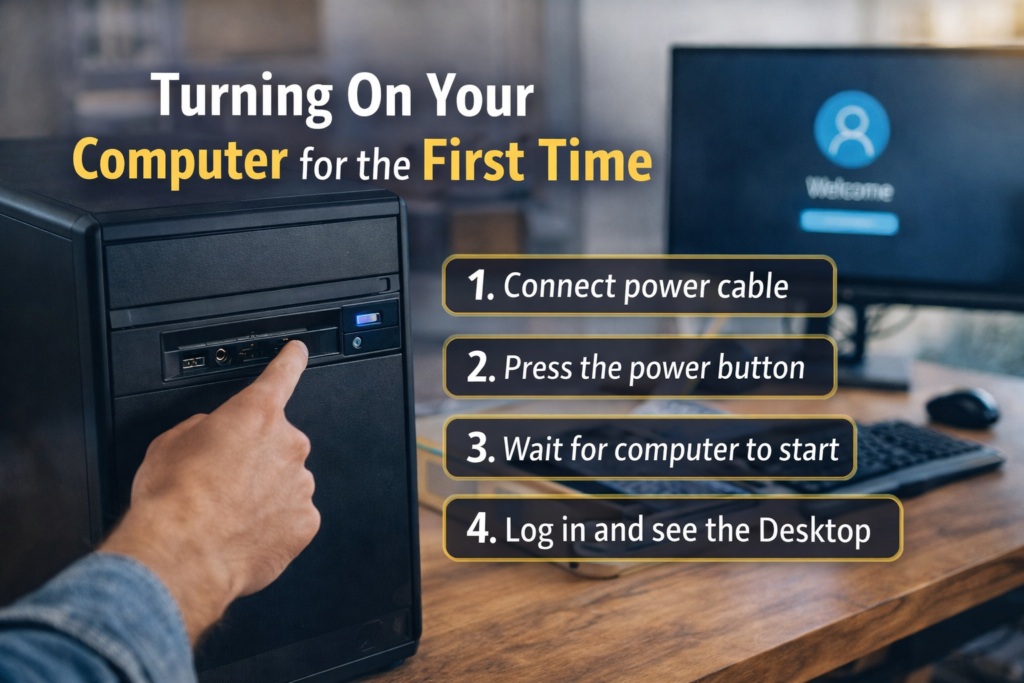
This is the most fundamental step every new user must learn. Here is exactly what you need to do:
Turning On:
- Connect the power cable properly to the computer and wall socket.
- Press the power button — on a desktop it is on the front of the tower, on a laptop it is above the keyboard.
- Wait 30 to 60 seconds for the computer to load.
- If a password screen appears, type your password and press Enter.
- The Desktop will load — you are now inside your computer!
Shutting Down Correctly:
- Click the Start button at the bottom left of the screen.
- Click the Power icon.
- Select Shut Down.
- Wait for the screen to go black before walking away.
Always shut down properly. Never pull the power plug while the computer is running — this can damage your files and slow down your system over time.
Part 3 — Navigating the Desktop
The Desktop is your home screen — the starting point for everything you do on a computer. Understanding it is essential for every new user.
Icons
Small pictures on the screen representing programs, files, and folders. Double-click any icon to open it.
Taskbar
The horizontal bar at the bottom of the screen. It shows open programs and gives you quick access to frequently used apps. The Start button sits on the left side.
Start Menu
Click the Start button to see all installed programs, system settings, documents, and the Shut Down option. This is the most powerful button on the computer.
Recycle Bin
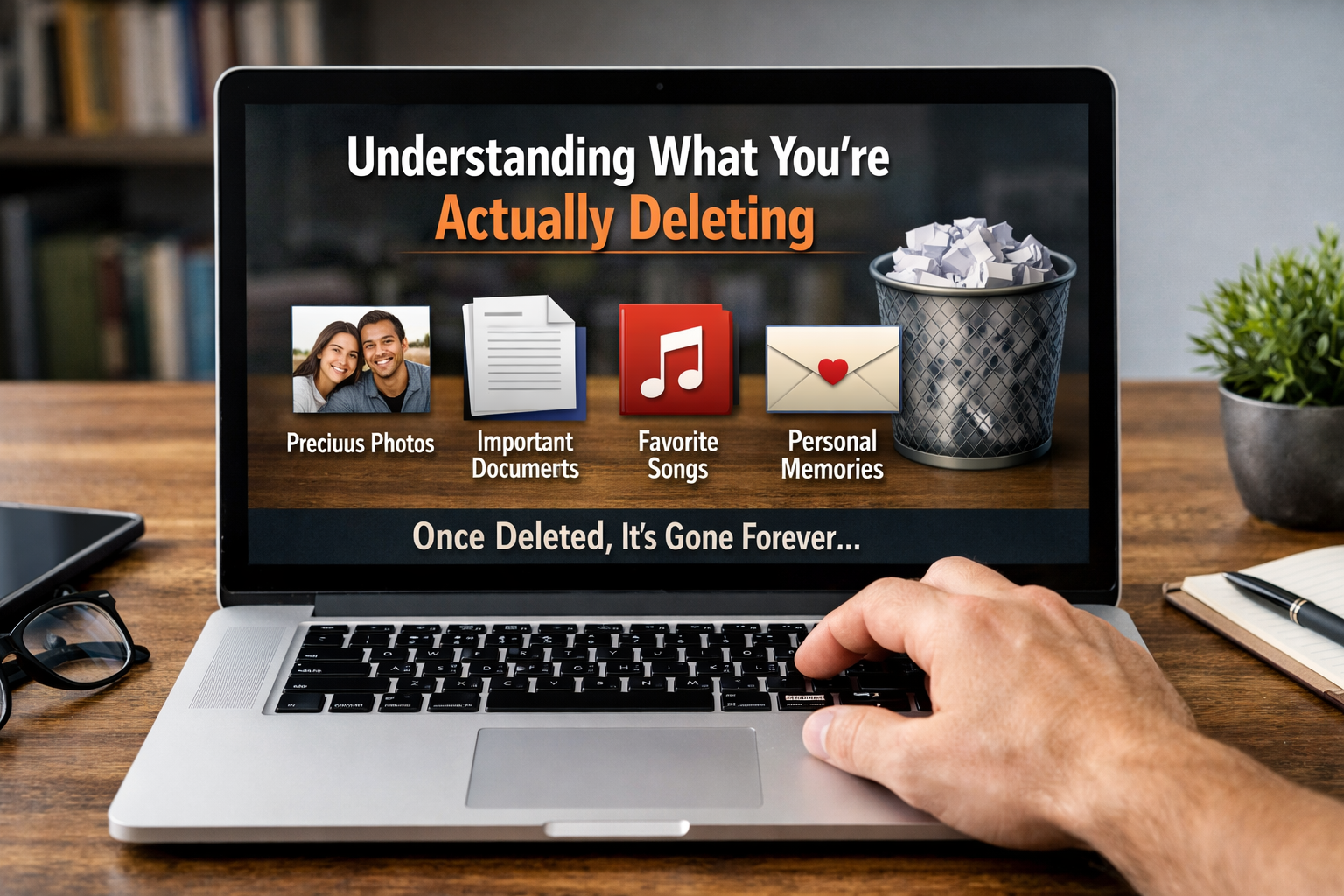
A temporary storage area for deleted files. If you delete a file by mistake, open the Recycle Bin and restore it easily. To permanently remove files, right-click the Recycle Bin and select Empty Recycle Bin.
System Tray
Located at the bottom right corner. Shows time, date, Wi-Fi, volume, and battery level (on laptops).
Part 4 — How to Use the Mouse
The mouse is one of the first things you will practice when learning basic computer skills for beginners. Here are all the essential mouse actions:
Left Click — Selects an item or presses a button. Used most of the time.
Double Left Click — Opens a file or program instantly. Click twice quickly without moving the mouse.
Right Click — Opens a context menu with extra options. Right-click on the Desktop to explore.
Click and Drag — Hold the left button, move the mouse, then release. Used to move files and resize windows.
Scroll Wheel — Roll forward to scroll up, roll backward to scroll down. Very useful on long web pages.
Practice these five actions for 10 minutes every day. Within a week, the mouse will feel completely natural in your hand.
Part 5 — Mastering the Keyboard
The keyboard is your most powerful tool. A good understanding of the keyboard is a core part of basic computer skills for beginners.
Important Keys
Enter — Confirms an action or starts a new line.
Backspace — Deletes the character to the left of your cursor.
Delete — Deletes the character to the right of your cursor.
Shift — Hold with a letter to type capitals. Hold with a number for symbols.
Caps Lock — Turns all capital letters on or off.
Tab — Jumps to the next input field. Great for filling forms.
Escape (Esc) — Cancels actions or closes pop-ups.
Spacebar — Adds a space between words.
Must-Know Keyboard Shortcuts
| Shortcut | Action |
|---|---|
| Ctrl + C | Copy |
| Ctrl + V | Paste |
| Ctrl + X | Cut |
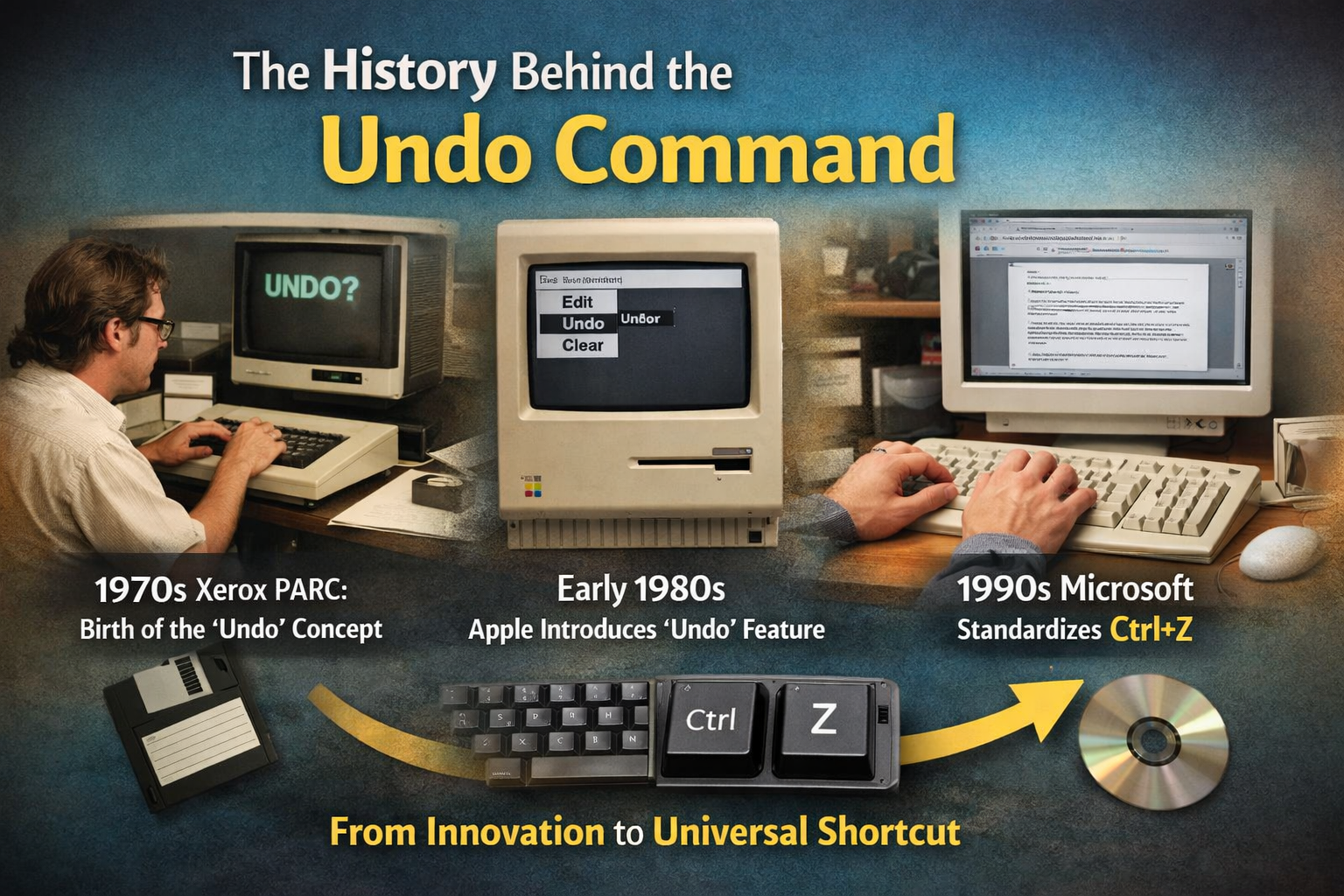
| Ctrl + Z | Undo |
| Ctrl + S | Save |
| Ctrl + A | Select All |
| Ctrl + P | |
| Ctrl + F | Find on Page |
| Alt + F4 | Close Window |
| Win + D | Show Desktop |
Memorize these shortcuts and you will work faster than most people around you.
Part 6 — Managing Files and Folders
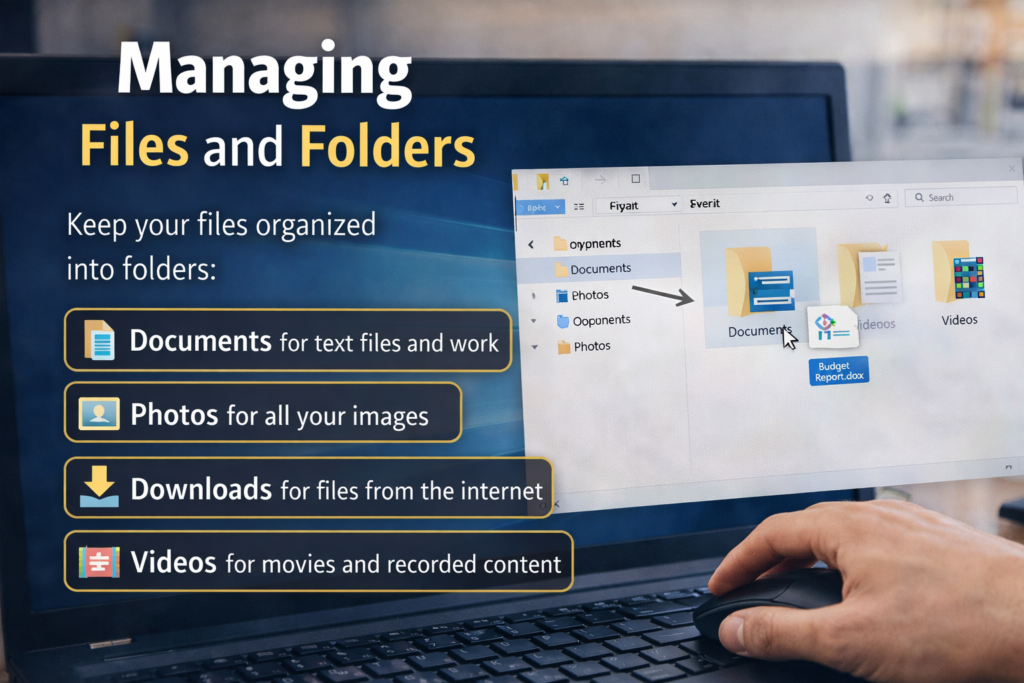
File management is a practical and essential part of basic computer skills for beginners. Think of folders like drawers in a filing cabinet — they keep your work organized and easy to find.
Create a New Folder
- Right-click on the Desktop or inside any folder.
- Hover over New and click Folder.
- Type a name and press Enter.
Move a File
- Click the file once to select it.
- Hold the left mouse button and drag it to the new location.
- Release to drop it.
Copy and Paste a File
- Right-click the file and select Copy.
- Open the destination folder.
- Right-click on empty space and select Paste.
Rename a File
- Right-click the file.
- Select Rename.
- Type the new name and press Enter.
Delete a File
- Right-click the file.
- Click Delete.
- The file moves to the Recycle Bin.
Recommended Folder Setup
- Documents — school work, reports, and text files
- Photos — personal and family pictures
- Downloads — files from the internet
- Videos — movies and recordings
Part 7 — Using the Internet for the First Time
The internet opens up the entire world to you. Learning to use it safely is a vital part of basic computer skills for beginners.
To access the internet, you need a web browser. Popular browsers include Google Chrome, Mozilla Firefox, and Microsoft Edge — all free to download and use.
How to Visit a Website
- Open your browser by double-clicking its icon.
- Click the address bar at the top.
- Type a web address such as www.google.com.
- Press Enter to go to that website.
How to Search on Google
- Go to www.google.com.
- Click the search box in the middle.
- Type your question or topic — for example “how to type faster.”
- Press Enter and click on any result that looks helpful.
Internet Safety Rules
- Never share your password with anyone online.
- Do not click on pop-up ads claiming you have won a prize.
- Only download files from websites you know and trust.
- Always log out after using websites on shared computers.
- Look for a padlock icon in the address bar — it means the site is safe and secure.
Part 8 — How to Send and Receive Emails
Email is the professional communication tool of the internet age and a key part of basic computer skills for beginners. Every job application, school submission, and official communication happens through email.
Create a Free Gmail Account
- Open your browser and go to www.gmail.com.
- Click Create Account.
- Enter your first and last name.
- Choose a username — this will be your email address.
- Create a strong password and confirm it.
- Verify your phone number when prompted.
- Your Gmail account is now ready to use!
Send Your First Email
- Log into your Gmail account.
- Click Compose at the top left.
- In the To field, type the recipient’s email address.
- In the Subject field, write a short clear title for your message.
- Write your message in the large box below.
- Click Send when you are ready.
Email Tips
- Always write a clear subject line so readers know what the email is about.
- Keep messages short, clear, and professional.
- Read through your email once before sending to catch errors.
- Never open email attachments from unknown senders.
Part 9 — Keeping Your Computer Safe and Fast
Taking care of your computer is just as important as knowing how to use it. Proper maintenance is a part of basic computer skills for beginners that many people overlook.
Windows Defender — Your Built-in Antivirus
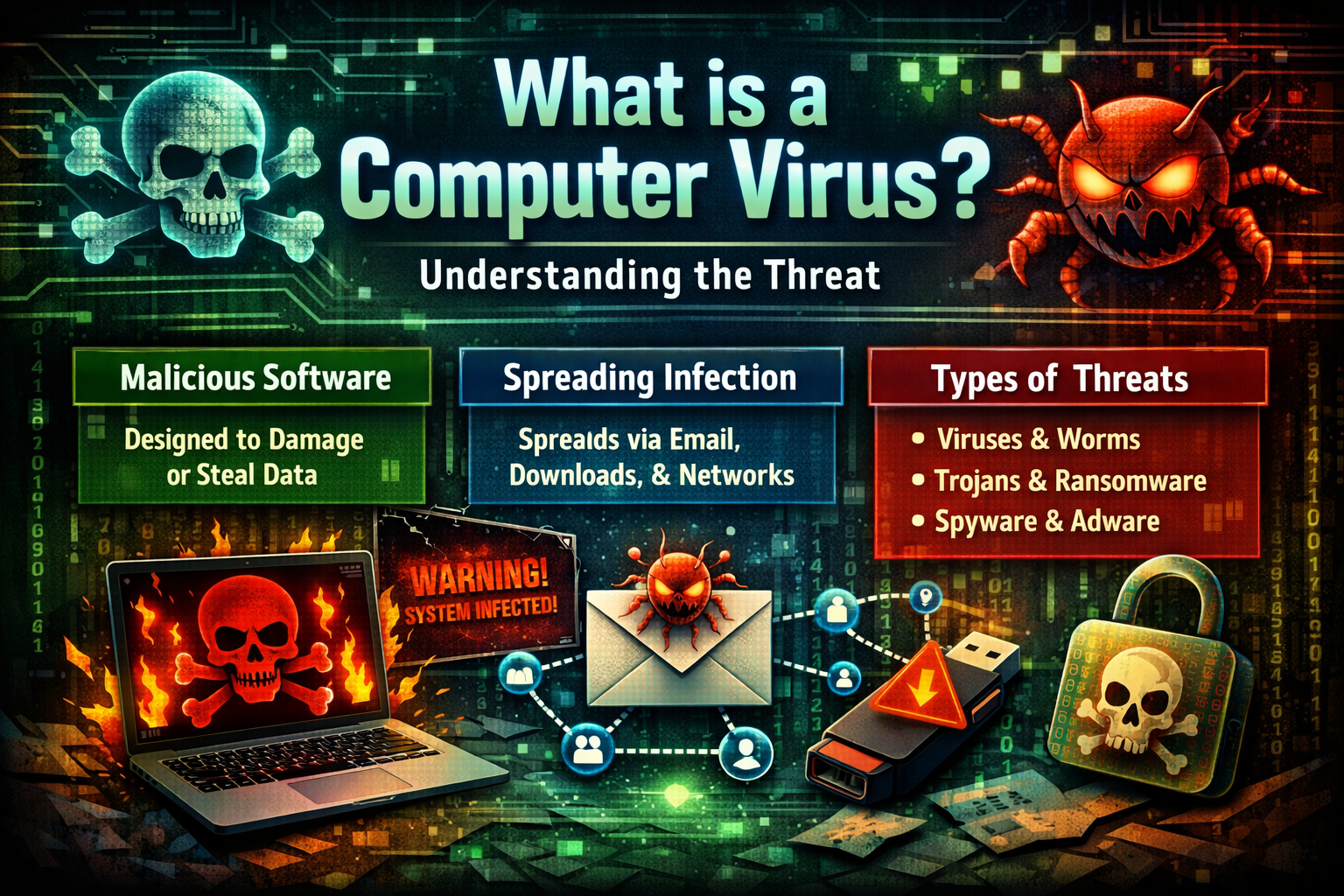
Windows 10 and 11 include a free antivirus called Windows Defender. Go to Settings, open Windows Security, and make sure all protections are turned on. This keeps viruses and harmful software away from your computer.
Install Updates Regularly
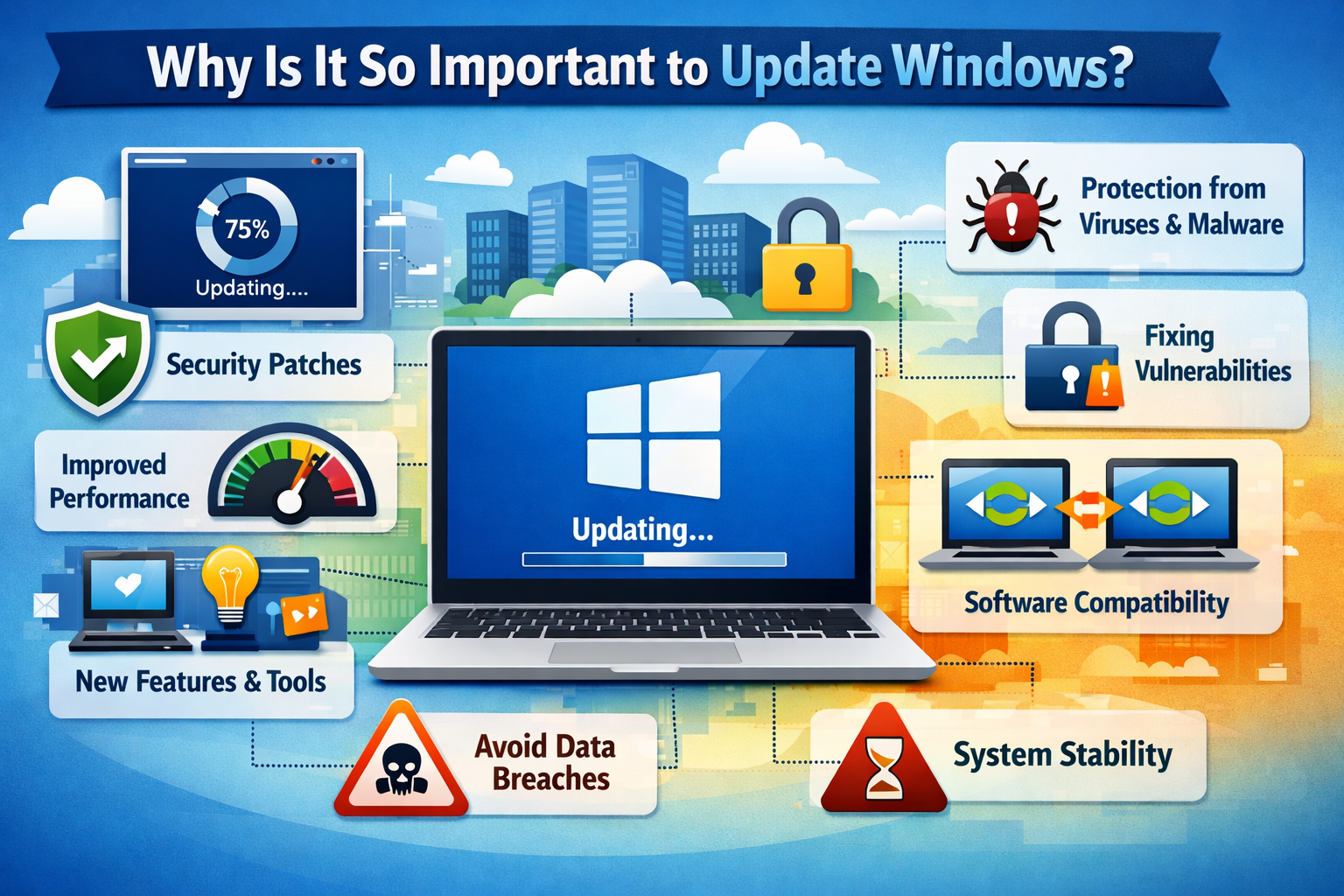
Click the Start button, go to Settings, and open Windows Update. Always install available updates. They fix security problems and improve how your computer runs.
Restart Your Computer Weekly
Restarting clears temporary files and refreshes your computer’s memory. It only takes two minutes and keeps your system running smoothly and quickly.
Run Disk Cleanup Monthly
Search for Disk Cleanup in the Start Menu. Select your main drive and let the tool remove junk files. You will often free up several gigabytes of storage space.
Back Up Your Important Files
Use Google Drive or an external hard drive to save copies of important documents and photos. If your computer breaks or gets infected, your data will still be safe and recoverable.Part 10 — Free Resources to Keep Learning
Now that you have covered the foundations of basic computer skills for beginners, it is time to keep building your knowledge. The more you practice, the more confident you will become. Here are the best free resources available today:
YouTube — Search any computer topic and find thousands of free video tutorials. Visual learning makes complex skills easy to understand.
GCFGlobal.org — One of the best websites in the world for learning computer and internet skills. Completely free, well-organized, and beginner-friendly.
Khan Academy — Offers free computing courses for all ages and skill levels. Great for students and adults alike.
Microsoft Learn — Official free tutorials from Microsoft covering Windows, Word, Excel, PowerPoint, and much more.
Coursera and edX — Free online courses from top universities worldwide. Many provide certificates you can add to your resume or job application.
Bonus: 8 Daily Habits That Will Make You Learn Faster
These simple daily habits will dramatically speed up your computer learning journey:
- Practice for 30 minutes every day — Consistency builds skill faster than any single long session.
- Use keyboard shortcuts regularly — The more you use them, the more automatic they become.
- Do not fear mistakes — Press Ctrl + Z to undo anything. Mistakes are how you learn.
- Explore menus and settings — Click around and see what different options do.
- Watch one tutorial video per day — YouTube has free lessons on every topic imaginable.
- Teach a friend what you learned — Teaching is the fastest way to truly understand something.
- Write down useful tips — Keep a small notebook for new shortcuts and tricks.
- Celebrate every small win — Every skill you master is a real step forward.
Frequently Asked Questions
Q: How long does it take to learn basic computer skills? A: Most beginners feel comfortable with daily tasks within 2 to 4 weeks of consistent practice. Full confidence comes within 2 to 3 months.
Q: Do I need to be good at maths or science? A: Not at all. Using a computer for everyday tasks requires zero maths or science knowledge.
Q: What is the best computer for a beginner? A: Any modern Windows laptop with at least 4GB RAM and 256GB storage is perfect for beginners. It will handle all everyday tasks easily.
Q: Can I learn computer skills completely for free? A: Yes! YouTube, GCFGlobal, Khan Academy, and Microsoft Learn are all 100% free.
Q: Is it too late to start learning at my age? A: Absolutely not. People of all ages — including seniors in their 70s and 80s — learn computer skills successfully every day. Age is never a barrier.
Final Thoughts
You have just completed a full, step-by-step guide on basic computer skills for beginners. You now know how to set up and navigate your computer, use the mouse and keyboard, manage files and folders, browse the internet safely, send professional emails, maintain your PC, and find free learning resources.
That is a powerful foundation to build on. The only thing left is action.
Close this guide, sit down at your computer, and start practicing right now. Begin with the mouse and keyboard. Then move to files and folders. Then explore the internet. Take it one step at a time and be patient with yourself.
Every confident computer user in the world started exactly where you are today. The difference is they kept going — and so will you.
You have everything you need. Start today!
“Learn more in our Basic Computer Skills for Beginners guide”
“For more information, visit the official Google website”